


9.14 megawatt SUNfarming PV rooftop systems in Germany
From December 2018 to February 2019, SUNfarming completed 9.14 megawatt rooftop systems in Germany in compliance with the EEG - in time for new special cuts by the legislator. Bank financing for the Group's own investment portfolio was confirmed by GLS Bank in March of this year.
The demand for on-roof PV systems for residential, commercial and industrial buildings with an installed capacity of less than 750 kWp have risen sharply in recent years.
For the electricity of rooftop photovoltaic systems with an installed capacity of less than 750 kilowatts peak (kWp), the operator receives a fixed remuneration in accordance with the Renewable Energies Act (EEG). In contrast, the operator of a plant with an installed capacity of more than 750 kilowatts peak must take part in a tendering procedure, whereby the level of support for the installations is determined in a competition.
Tenders are very expensive, the electricity produced may not be used for own use according to the EEG and the amount of subsidy depends on the cheapest provider.
Another advantage of rooftop systems compared to open space PV systems is that no building application has to be made for the construction.
A 750 kWp photovoltaic system can produce an average of 700,000 kilowatt hours of electricity per year, which corresponds to a power consumption of around 250 households
Photovoltaic systems (PV systems) make an important contribution to climate protection. In 2017, more than 39,300 gigawatt hours of electricity were generated by PV systems in Germany, which can supply around 12 million households.

Magazine Estrel Story, an interview with Peter Schrum
For the 25th anniversary of the Estrel, the internationally known hotel presents itself with the new magazine Estrel Story.
Hankering for fresh, rooftop harvested vegetables seasoned with homegrown herbs? Then you’re in the right place at the Estrel! Not only does our rooftop offer a phenomenal view of Germany’s capital city, but ever since last summer, the hotel’s executive chef, Peter Griebel, has been harvesting organic vegetables such as tomatoes, zucchini and cucumbers from the new rooftop greenhouse.
Find the interview with Peter Schrum, SUNfarming company founder and main shareholder, from page 20 onwards and read how the Food & Energy project brings tomatoes to the hotel roof.
Rooftop tomatoes, an Interview with Peter Schrum

SUNfarming Food & Energy provides emergency aid in Mozambique
The SUNfarming group from Erkner uses its years of experience in Africa and sends whole-food to the disaster area.
Tropical cyclone Idai has left a trail of devastation in southern Africa. In Mozambique, Zimbabwe and Malawi, around two million people are in urgent need of assistance. There is a lack of drinking water, food and medicines. Zimbabwe, Mozambique and Malawi are among the poorest countries in the world. Where there used to be frequent drought, the few fertile fields are now under water. Rivers burst their banks, flash floods and landslides threaten settlements.
Hundreds of thousands of people have lost everything. The situation is dramatic.
The ambassador for Food Security in Africa, Dr. Brylyne Chitsunge of the African Parliament in Johannesburg has asked for support from Peter Schrum as President of the BRM (Federal Association for Regenerative Mobility e.V.).
Fast, unbureaucratic help was required. With Peter Schrum, the phone was no longer quiet until all necessary steps for a first aid delivery were initiated.
SUNfarming and our South African Food & Energy partners from CFAM Technologies today ship the first 10 tons of food aid to Mozambique. Transport from South Africa is organized by Coca Cola and distributed by Mozambique's Ministry for Disaster Management to children and the elderly in the crisis areas.
The aid package, funded by SUNfarming, CFAM and Botselo Holdings, consists of the dry product Pre-Cooked Porridge, which consists of corn, soy, grains, minerals and vitamins. With only 14 euro cents per day, two whole-meal meals ensure the life of a person.
As a SUNfarming Group and BRM, we are happy to provide the needy with fast food emergency aid“, explains Peter Schrum, President of BRM and SUNfarming Chairman. „We have already developed the first porridge whole-foods based on our Food & Energy Public Private Partnership project launched at KfW / DEG since 2013, at North-West University in Potchefstroom, South Africa. In addition to the vegetable and fish production under the solar modules in the training center, SF Porridge was provided in the townships to provide basic services to our staff and trainees. The existing partnership with CFAM Technologies, led by Prof LJ Grobler, has enabled our fast and efficient relief effort to be delivered to Mozambique. Today, through years of experience and networks in Africa, we are able to provide large quantities of whole foods in 1 and 10 kilo packages for disaster areas and the needy at very low cost in the short term.
Our first aid delivery is leaving South Africa today. 10 tonnes of whole foods ensure survival for 10,000 children for three weeks.
Should additional funding be available, we will immediately send more trucks with food to Mozambique within a few days, "so Peter Schrum.

christmas wishes
"Coming together is a beginning,
staying together is progress,
working together is success.
- Henry Ford
In this spirit, we wish you and your families a merry Christmas and a happy holiday season. Health, happiness and much success for the New Year - combined with our heartfelt thanks for your trust!
With festive greetings
Your SUNfarming Team

6 x 750 kWp SUNfarming solar plants
With a total order value of 6 million euros, four ground-mounted systems and two rooftop systems, each rated at 750 kWp in Germany, were successfully completed by SUNfarming GmbH.
The municipalities of Reisdorf, Wegleben, Wolmirsleben, Harzgerode, Hennickendorf and Zahna are committed to sustainability with the construction of solar energy systems, thus making a valuable contribution to a regional energy supply. The plants were partly completed in November or EEG compliant completed until 31th of decembre this year, the grid connection is a short time later.
Each 750 kWp plant supplies clean and green electricity for more than 240 households. The CO2 savings per plant are 440,000 kg / year, on average as many as 165 middle-class cars (8l / 100km) emit per year.
"Our range of investors spans the entire breadth, from project development to service and monitoring, all from one source. We have developed a unique quality assurance system for banks and investors. Our PV components are based exclusively on high-quality materials. In addition to the certification by the TÜV Rheinland and the Photovoltaikinstitut Berlin, SUNfarming experts for quality assurance check the module factories unannounced and monitor the production for all technical components according to a particularly strict system.
An average of 7% additional capacity from our systems over the past few years confirms the premium quality of our components, "explains Martin Tauschke, SUNfarming Managing Director.
Energy self-sufficient with SUNfarming solar power
The "Hotel am Peenetal" is the first hotel in Germany that can be operated by renewable energy alone from 2018.
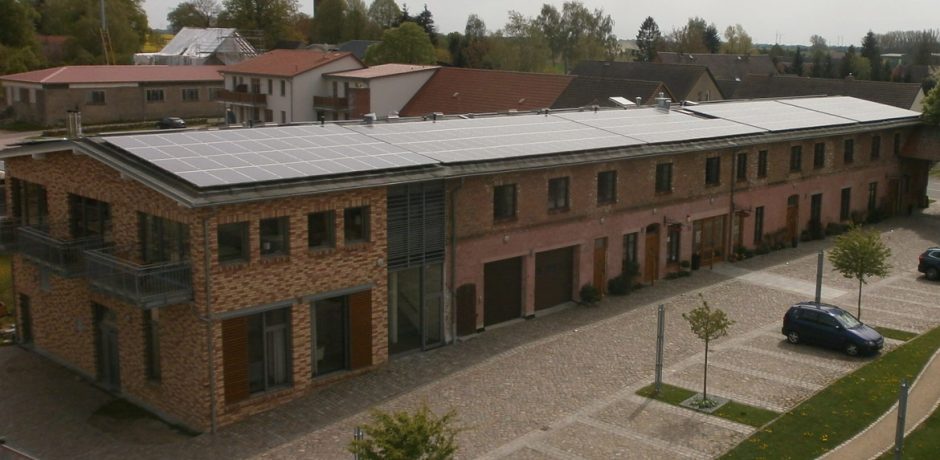
A total of 200 kWp SUNfarming Solar systems provide the 2008 completed complex, including a spa with brine basin and swimming pool, with solar power in the future. Installed 120 kWp on the former cowshed and 80 kWp distributed on 5 carports. An energy concept was established even before the start of construction. In addition to the PV systems, heat is obtained from heat pumps with deep bores. A Eventsaal with 200 seats is heated with floor and wall heating. In principle, only LED lighting is used and an energy-saving technology ensures the water treatment.
"In the future, the hotel will be able to operate with renewable energy alone. This is probably unique for Germany and the project is waiting for imitation, "explains Julius Jäger, SUNfarming project manager.
News

15. August 2026

29. June 2026

10. June 2026

23. March 2026
SUNfarming GmbH
D - 15537 Erkner (bei Berlin)
Sitemap
News
15. August 2026
29. June 2026
10. June 2026
Newsletter
Contacts | imprint
By loading the map, you accept Google's privacy policy.
Learn more