


Steinhöfel
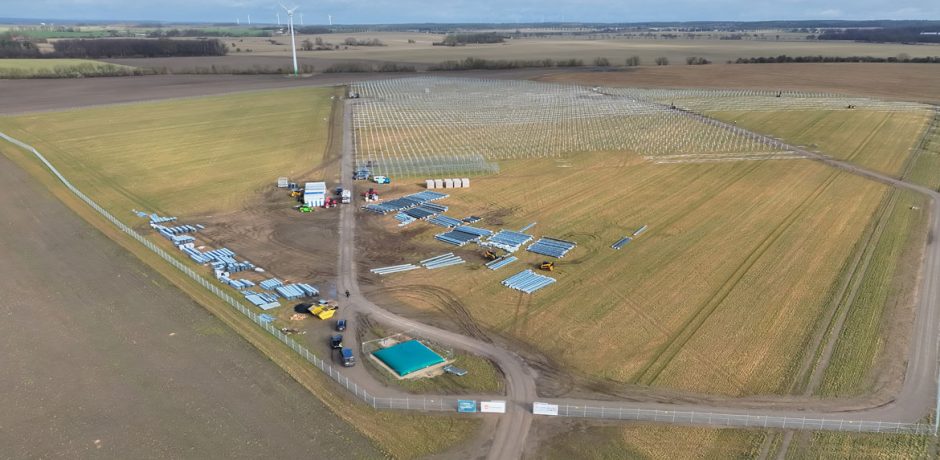
SUNfarming GmbH begins construction on one of Europe’s largest Agri-PV projects
Erkner, 19 March 2026 – Steinhöfel Climate Park sets new standards for the energy transition and agriculture. With the start of construction on one of Europe’s largest agri-photovoltaic projects, SUNfarming GmbH aims to play a key role in driving forward the sustainable energy transition in Brandenburg. The Klimapark Steinhöfel, set to be built in the municipality of Steinhöfel in the Oder-Spree district, is set to become one of Europe’s most ambitious energy and sustainability projects.
The entire Steinhöfel Climate Park covers around 500 hectares across eight districts of the Brandenburg municipality and, once fully developed, is expected to feed a total installed capacity of up to 753 megawatts peak (MWp) into the grid. Building permits have already been granted for the first 550 MWp of agri-PV and the associated substation.
The substation is being built by SUNfarming GmbH in collaboration with SPIE. It will feed the green electricity generated into the high-voltage grid of the regional distribution system operator E.DIS via 110 kV cable systems.
SUNfarming was awarded a contract for the EEG feed-in tariff in the July tender for the first phase, with a capacity of 106 MWp; the entire project is an agri-PV plant with agricultural land beneath it. This is made possible above all by close cooperation with active farmers and agricultural companies in the region. Construction of the first phase of the project began as early as the fourth quarter of 2025.
Martin Tauschke, Managing Director of SUNfarming GmbH, explains:
“With the EEG grant for the first 106 MWp, we believe we have reached a decisive milestone in the implementation of the Steinhöfel Climate Park. The start of construction on the first phase marks the transition from planning to implementation. We are proud that our agri-photovoltaic concept has once again proven itself to be a forward-looking model for sustainable energy supply. Together with our partners, the local council and local farmers, we are working to create a project here that can set new standards across Europe for combining energy production, agriculture and regional value creation.”
Forward-thinking agriculture meets sustainable energy
The Steinhöfel Climate Park is designed to combine state-of-the-art solar technology with sustainable agricultural use, creating a forward-looking integration of energy production, biodiversity and regional economic growth. The agricultural use of the land is to be maintained.
At the heart of the project is the dual-use Agri-PV concept: state-of-the-art bifacial glass-on-glass modules are to be permanently installed at a minimum height of 2.10 metres. This will create sufficient space beneath the modules for agricultural cultivation – such as the growing of medicinal and aromatic herbs or crop rotation.
Working closely with the municipality of Steinhöfel, local farmers, the district authority and technical partners such as SPIE and E.DIS Netz GmbH, SUNfarming is taking a holistic approach; the Climate Park is designed not only to generate clean electricity for numerous households, but also to boost regional economic growth, create local jobs and open up new economic opportunities for rural areas.
With the Steinhöfel Climate Park, SUNfarming aims to create not just a solar power plant, but a flagship project for the energy transition, sustainable agriculture and regional development – one whose influence will extend far beyond Brandenburg.

SUNfarming is planning a 500 MW agro-solar park in Brandenburg
The following article is a translation and was published on December 4th, 2020 in the Spreejournal Fürstenwalde, Bettina Winkler)
Steinhöfel relies on the sun
Five farmers from the Odervorland office are providing areas for a photovoltaic park, which is to become one of the largest in Brandenburg.
Farmers in the region have been concerned for years and are fighting to keep their farms going. Due to climate change, the amount of precipitation has almost halved in the last 30 years and the productivity of the soil is declining more and more.
The Sunfarming GmbH from Erkner is now promising farmers from the Steinhöfel community income independent of traditional agriculture. Double-use photovoltaic systems are to be built on low-yield soils. Means: On the one hand, solar energy is generated by the higher-placed modules. On the other hand, the areas below can still be used for agriculture.

Trees shield systems
The aim is to create a climate park that is spread over several areas. The systems should stand outside the field of vision and be shielded by hedges or rows of trees. The operator expects a total output of over 500 megawatts. This would make the future project one of the largest in Brandenburg. The community representatives are aware of the importance of the project and see a great opportunity for rural areas. They unanimously decided to initiate the necessary changes to the development plan and the land use plan in the individual districts. “The project is a huge opportunity for our company. We have long been looking for land use that is independent of the weather and offers financial security, ”says Benjamin Meise, Managing Director of Fürstenwalder Agrarprodukte GmbH. "Many farmers are up to their necks". Benjamin Meise has already selected abandoned or low-yield areas for the climate park.
Set-aside areas or low-yield soils are built on with modules.
The OderSpree district farmers' association also takes the view that photovoltaic systems belong on roofs, commercial and special buildings as well as conversion areas. For free-field systems, primarily non-agricultural areas are to be used. "In the case of agro-photovoltaic systems, on the other hand, the areas used for agriculture are not lost and can continue to be cultivated," says district manager Dr. Karsten Lorenz. In his opinion, the planned system in Steinhöfel should therefore be seen more as a pilot system in which several farmers have come together to test the new type of management using photovoltaics on very low-yield locations in terms of economy and profitability.
For Sunfarming from Erkner, the solar park on the planned scale is a pilot project.
News

15. August 2026

29. June 2026

10. June 2026

23. March 2026
SUNfarming GmbH
D - 15537 Erkner (bei Berlin)
Sitemap
News
15. August 2026
29. June 2026
10. June 2026
Newsletter
Contacts | imprint
By loading the map, you accept Google's privacy policy.
Learn more