


News

443.000 kg CO2-savings per year
443.000 kg CO2-savings per year
Another SUNfarming solar park was successfully completed in November in Roggentin in Mecklenburg Vorpommern. With a total output of 750 kWp, it supplies clean, green electricity for more than 240 households. The CO2 savings of the solar park in Roggentin amount to considerable 443.305 kg / year.
Asked: How much CO2 does a car produce?
Again and again there is talk of the climate killer CO2. The invisible gas is partly responsible for the warming of the climate and transforms our planet into a greenhouse. But although much is discussed, many of us have no feeling for it. How much carbon dioxide - or CO2 for short - does your car produce?
A concrete example: You drive a mid-range car, consumption: 8l / 100km; the tank volume is 55 liters. Since gasoline is lighter than water, this results in about 40 kilograms of gasoline per refueling process. This gas is burned in the engine. In the process, the carbon in the gasoline combines with the oxygen from the air, resulting in CO2.
One kilo of gasoline, which consists essentially of carbon, thus leads to over 3 kilograms of CO2 in the combustion! Thus, there is much more carbon dioxide than the gas weighs. With every tankful of fuel, our car produces about 150 kilos of CO2 (exactly: 144.6 kg) and after just under 9 x full tanks we have produced as much CO2 while driving as our car weighs! With an annual mileage of 12,000 kilometers per year, we blow up twice the weight of our car on average in the air! Even more with super-powered sports cars. Each year.
The CO2 savings of the solar park in Roggentin amount to 443,305 kg / year, as many as 165 cars emit in the example per year.

SUNfarming solar energy for 1600 households
SUNfarming solar energy for 1600 households
The SUNfarming photovoltaic plants on the former landfill Seelow and Hennickendorf in the district Märkisch Oderland in Germany were officially handed over on 03.11.2017. District administrator Gernot Schmidt and EMO works director Angela Friesse were attending the handing over. The power generated can supply more than 1,600 households with electricity.
Karsten Balzer, authorized signatory of SUNfarming, described the facilities as win-win projects. "Both, SUNfarming and the district Märkisch Oderland, benefit from it. SUNfarming takes over the long-term care and security of the refurbished landfills with the leases that are limited to 27 years, "explained Balzer. The 150,000 m2 landfill site in Hennickendorf, or 39,191 m2 in Seelow, were fenced in for protection. During the construction of the facilities, the properly covered landfill body was not to be damaged. In Seelow a special concrete base was created for this purpose. Both systems are equipped with a remote monitoring system. Faults or damage are reported immediately. Thanks to the support of the district, the construction of the freefield plants was possible, emphasized Balzer.
For the district, the plants have meaning in many ways, said district administrator Gernot Schmidt. "They correspond to the energy concept of the district, where renewable energies are very important," he said. Even today, these energies in the district would generate 130 percent of the electricity needed in households. On the other hand, it would eliminate the care and maintenance costs for the EMO as owner. "And the leasing income benefits the citizen," says Schmidt. For the three landfills covered with SUNfarming solar modules in Wriezen, Hennickendorf and Seelow, these are around 20,000 euros per year, added EMO works director Angela Friesse. The money flows into the fee calculation.
Numbers and facts:
■ Landfill Hennickendorf: 7200 modules, total capacity of 1500 kW. Performance: The plant generates electricity for about 600 households.
■ Landfill Seelow 11 808 modules, total capacity 2460 kW. Performance: The plant in Seelow generates electricity for approx. 1000 households.
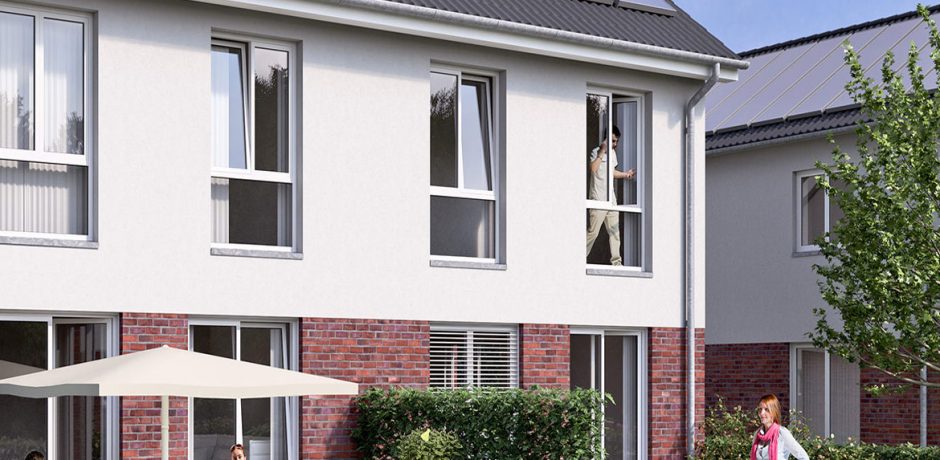
New Hamburg residential district relies on SUNfarming solar roofs
In the past 1 ½ years, 36 newly built energy-efficient houses belonging to the developer BONAVA have been equipped with SUNfarming PV systems in the south of Hamburg.
The roofs of 8 single-family houses, 14 duplex-houses and 14 townhouses now provide regional, renewable electricity for the residents. As the plants deliver more than they consume, excess green electricity can be fed into the grid.
The Swedish word "bo" means living, and "nav" means center. BONAVA does not just want to build houses but create a home for the residents in a pleasant environment in which they feel comfortable. This includes a sustainable supply of renewable solar energy. 1016 SUNfarming quality modules bring a total capacity of 300 kWp. With the SF AS-295-60M black frame modules, BONAVA has opted for frameless modules that fit seamlessly into the overall architectural concept. Every year, a considerable 159,128.00 kg of CO2 are saved and thus make a contribution to the energy transition.
As was the case in the past, the costs of purchasing electricity are set to rise further.
Solar electricity is already the cheapest source of energy worldwide.
Benefits for BONAVA and its residents through SUNfarming photovoltaik on its own roof
o Partial own energy supply for approximately 10 cent/Kwh via unique SUNfarming quality assurance system
o Up to 20 years of cost security with your own solar electricity
o Immediate cost benefit through long-term fall in ancillary costs
o 100 % greener electricity
o Offensive marketing argument with the protection of fossil energy sources
o No additional or hidden costs
o High quality technology and installation
o Option on innovative SUNfarming electricity storage technology
o Security of supply, independence from energy suppliers abroad
o Own electricity from the roof for electromobility and your own vehicle fleet
INVEST IN A SOLAR PLANT AND SECURE YOUR ELECTRICITY PRICE FOR OVER 20 YEARS
Learn more about the SUNfarming investment concept
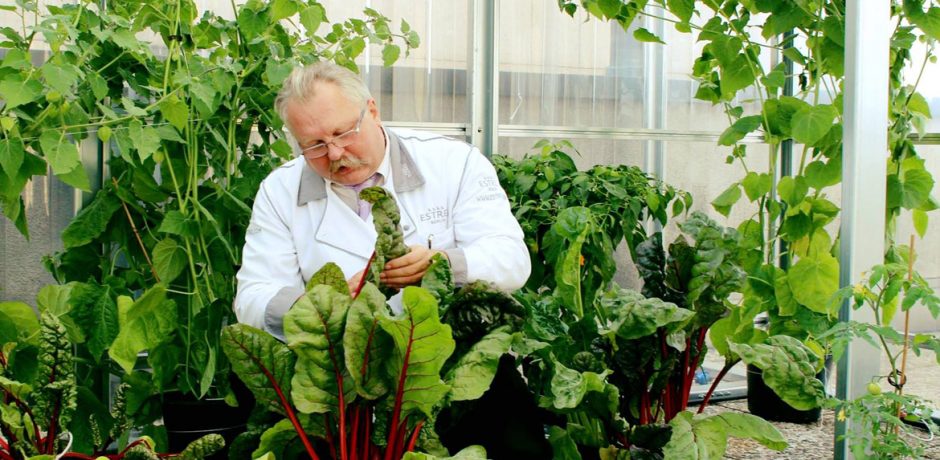
Tomatoes from the hotel roof
On the sun terrace of the Estrel in Berlin, the largest hotel in Europe, SUNfarming has built its agro-solar greenhouse
The greenhouse, covered with a 4 m wide light dome, has a size of 42.5m² (5m x 8.5m). The roof tops, east and west of the light dome, are equipped with SUNfarming modules, the generated solar electricity is used directly by the hotel.
The "SF Urban Farming Concept", developed by SUNfarming, produces sustainable solar energy and regional food - on the same place. In addition to the solar power, vegetables, fruits, flowers or fish can be gained between the modules of new or already built PV free-field plants or in special agro-solar Food & Energy greenhouses.
Here, from one of the highest points of the Estrel, Peter Griebel, the kitchen director, not only enjoys a magnificent view over Berlin, but here he is now harvesting herbs, cauliflower, chili, chard and physalis, to mention only a few. Regionally and sustainably produced finesse and highlights for the hotel kitchen.
Learn more about the SUNfarming Urban Farming Concept:

30,000 m² Food & Energy training plants planned in Knesebeck
Butting GmbH in Knesebeck has promised to promote the first joint investment project of SUNfarming and KoNaMo (Competence Network for Sustainable Mobility as a Project Developer)
The metal-working Butting Group provides almost 3 ha of land for the construction of the first KoNaMo-SUNfarming oasis for food & energy in Germany. The parcel is located directly behind the site and is leased for the project. 100% of the generated energy is taken from Butting, also on the weekends!
KoNaMo is based in Berlin, where actors and strategies, technologies and deployment scenarios for sustainable mobility are brought together in Germany. For members and partners, synergies are created that are in harmony with ecological and economic ideals. The integration and qualification of refugees from war zones remains an urgent problem for many municipalities.
The joint investment project KoNaMo-SUNfarming-Oases for Food & Energy aims to give these people a meaningful training in which they acquire quickly and purposefully basic knowledge and qualifications in healthy food production. This acquired knowledge gives people courage and confidence. In addition, the participants have an excellent perspective, should they return to their home countries sooner or later.
The SUNfarming Food & Energy Training Concept of Solar Greenhouses has been successfully applied and tested in Africa. South Africa has the best experience and we want to establish this concept also in Germany.
Learn more about KoNaMo: www.konamo.de

SUNfarming opened 3.2 MW Solarpark Mühlenbeck
SUNfarming opened 3.2 MW Solarpark Mühlenbeck
Another SUNfarming solar park was successfully completed in Mühlenbeck in the Oberhavel region.
"Mühlenbeck" is a solar park of superlatives: on an area of 55,000 m² on the former landfill, 12,048 solar modules of the type SUNfarming SF-AT235-60P with 260 and 265 Wp power were installed. The SUNfarming quality modules and inverters used are all "Made in Germany". The energy produced in this way of 3,229,800 kWh can supply 1,000 2-person households with clean solar power in the year. In addition, SUNfarming is contributing around 1,937.511 kg of CO2 emissions this year, which corresponds to the output of approximately 750 medium-class cars.
Up to 50 fitters and technicians have carried out a "small miracle" and rammed up to 5000 posts, sometimes up to 1.20 m deep, into the ground, 516 "tables" and the modules were mounted.
SUNfarming invests 3.5 million euros from planning to completion of the plant. The leasing contract for the landfill site is over 20 years with an extension option of 5 years.
„Thanks to the good cooperation of politics, management and the executive companies the solar park could be established in record time“, said Managing Director Martin Tauschke. This excellent teamwork was also necessary, since plants of this size will no longer be possible from 2017, according to lawmakers. The upper limit will then be 0.75 MW. 3 days before Christmas 2016 the building permission was granted.
For the building authority manager Hans-Werner Labitzki the use of the landfill site is a sensible and sustainable after-use, valuable agricultural areas are spared. Furthermore, the safety fence built around the solar system prevents the possibility that wild boars could exploit old rubbish, as happened in the past.
Mayor Fillipo Smaldino-Stattaus is also pleased with the completion of the plant:
"The municipality's trade tax revenues are rising and the municipality is saving the costs of securing and maintaining the area. Again, a puzzle piece has been found on the way to the green community of Mühlenbecker Land ".
News

15. August 2026

29. June 2026

10. June 2026

23. March 2026
SUNfarming GmbH
D - 15537 Erkner (bei Berlin)
Sitemap
News
15. August 2026
29. June 2026
10. June 2026
Newsletter
Contacts | imprint
By loading the map, you accept Google's privacy policy.
Learn more