


News

CircularFarming.IN.NRW: SUNfarming Explores the Combination of Hydroponics and Agri-PV
Erkner |Sustainable agriculture goes beyond Agri-PV. As part of the CircularFarming.IN.NRW project, SUNfarming GmbH, together with TH Köln and Nourtec GmbH, is developing and testing innovative concepts that combine Agri-Photovoltaics (Agri-PV) with hydroponic cultivation systems.
The project aims to explore the potential of hydroponic farming under the specific conditions created by Agri-PV systems and to develop new approaches for resource-efficient and future-oriented agriculture. The focus is on the technical, agronomic and economic requirements that are essential for the successful integration of hydroponic systems into Agri-PV projects.
To achieve this, several demonstration systems will be installed and tested under real-life operating conditions. The knowledge gained will be used to develop a planning model that supports the design and implementation of hydroponic systems within Agri-PV installations.
The model will serve as a practical decision-making tool for project developers, farmers and other stakeholders. It will help assess which hydroponic systems are best suited to specific Agri-PV conditions and provide guidance for their efficient planning and operation.
Through this research project, SUNfarming is making another important contribution to the advancement of sustainable land-use concepts. The intelligent combination of Agri-PV and hydroponics opens up new opportunities for resource-efficient food production while simultaneously generating renewable energy.
The project was selected as part of the GreenEconomy.IN.NRW competition and is funded by the State of North Rhine-Westphalia and the European Union through the ERDF/JTF Programme North Rhine-Westphalia.
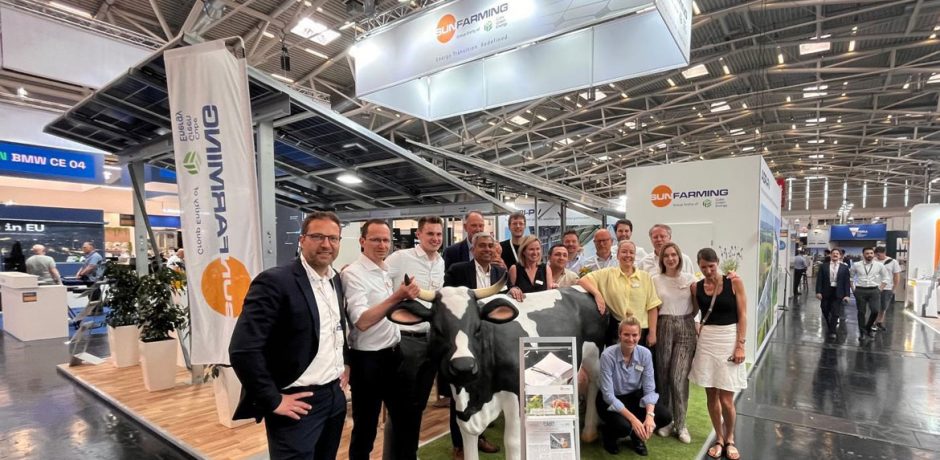
That´s a wrap on Intersolar Europe 2026
Three inspiring days at Intersolar Europe 2026 in Munich have come to an end. We’re looking back on many engaging conversations with customers, partners, industry experts, and visitors—all driven by a shared commitment to advancing the energy transition and developing sustainable solutions for the future.
This year once again, SUNfarming’s Agri-PV solutions attracted strong interest. Farmers and project developers were particularly interested in how agricultural land can be used simultaneously for high-value crop production and renewable energy generation. These discussions confirmed that Agri-PV is increasingly being recognized as an essential component of sustainable and economically viable agriculture.
As part of the Cube Green Energy Group, SUNfarming contributes more than 15 years of experience in Agri-PV to the development of integrated energy solutions that combine renewable energy generation with sustainable land use.
Another key topic throughout the exhibition was the integration of different renewable energy technologies. Agri-PV is increasingly being incorporated into holistic energy concepts alongside battery storage, wind power, biogas, and, looking ahead, electrolyzers for decentralized green hydrogen production.
At the same time, agricultural robotics is opening up new opportunities to make farming more efficient, precise, and resource-conscious.
A sincere thank you to everyone who visited our booth. We truly appreciated your interest, insightful questions, and inspiring conversations. We would also like to thank our dedicated team, whose commitment and teamwork made our presence at Intersolar Europe such a success.
We look forward to continuing these conversations, reconnecting soon, and working together to shape the future of renewable energy.
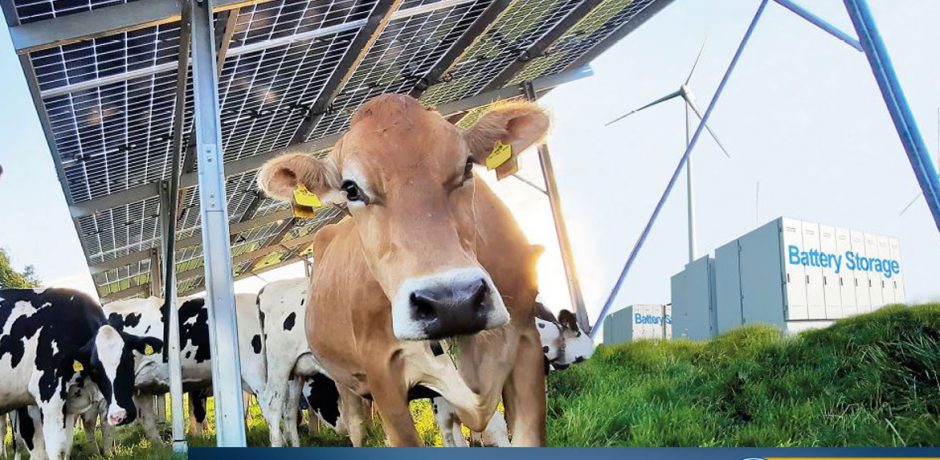
Meet SUNfarming at Intersolar Europe 2026 -Shaping the Future of Agriculture with Innovative Solutions such as Agri-PV and Autonomous Agri-Robotics
From June 23–25, 2026, SUNfarming will showcase its proven agrivoltaics solutions for livestock farming, crop production, and specialty crops at Intersolar Europe in Munich (Hall C4.330).
With more than 20 years of experience, SUNfarming is among Germany’s leading developers of agrivoltaics projects. As part of the Cube Green Energy group, the company delivers innovative and resilient solutions for the energy transition—from Agri-PV and solar projects with integrated battery storage systems to the repowering of onshore wind farms.
The combination of Agri-PV, battery storage, and agricultural robotics opens up new opportunities for sustainable, economically viable, and future-ready farming.
Visitors to the SUNfarming booth will gain first-hand insights into how these technologies are being deployed to integrate renewable energy generation with sustainable agricultural use.
Planning to Visit Intersolar Europe?
June 23–25, 2026
Messe München, Munich
Visit SUNfarming at Hall C4.330 and discover how Agri-PV shaping the future of agriculture while accelerating the transition to renewable energy.
To schedule a meeting or arrange a personal consultation, please contact:
j.gathani(at)sunfarming.de
We look forward to meeting you in Munich.
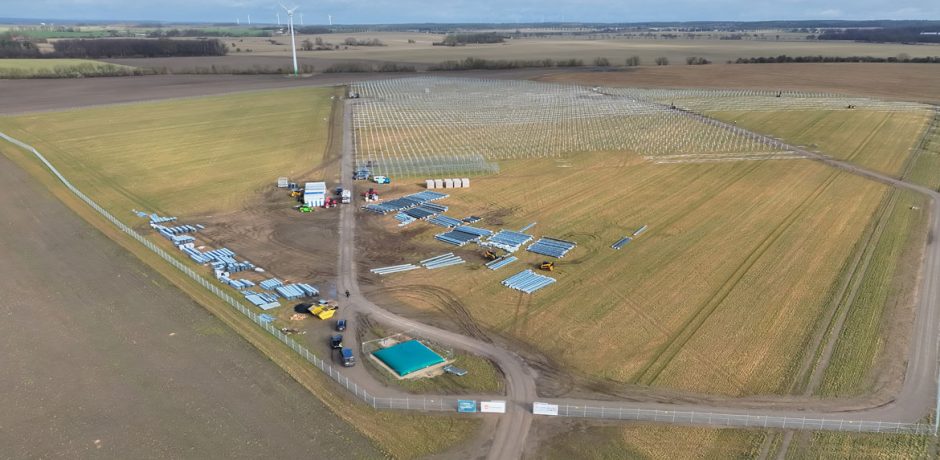
SUNfarming GmbH begins construction on one of Europe’s largest Agri-PV projects
Erkner, 19 March 2026 – Steinhöfel Climate Park sets new standards for the energy transition and agriculture. With the start of construction on one of Europe’s largest agri-photovoltaic projects, SUNfarming GmbH aims to play a key role in driving forward the sustainable energy transition in Brandenburg. The Klimapark Steinhöfel, set to be built in the municipality of Steinhöfel in the Oder-Spree district, is set to become one of Europe’s most ambitious energy and sustainability projects.
The entire Steinhöfel Climate Park covers around 500 hectares across eight districts of the Brandenburg municipality and, once fully developed, is expected to feed a total installed capacity of up to 753 megawatts peak (MWp) into the grid. Building permits have already been granted for the first 550 MWp of agri-PV and the associated substation.
The substation is being built by SUNfarming GmbH in collaboration with SPIE. It will feed the green electricity generated into the high-voltage grid of the regional distribution system operator E.DIS via 110 kV cable systems.
SUNfarming was awarded a contract for the EEG feed-in tariff in the July tender for the first phase, with a capacity of 106 MWp; the entire project is an agri-PV plant with agricultural land beneath it. This is made possible above all by close cooperation with active farmers and agricultural companies in the region. Construction of the first phase of the project began as early as the fourth quarter of 2025.
Martin Tauschke, Managing Director of SUNfarming GmbH, explains:
“With the EEG grant for the first 106 MWp, we believe we have reached a decisive milestone in the implementation of the Steinhöfel Climate Park. The start of construction on the first phase marks the transition from planning to implementation. We are proud that our agri-photovoltaic concept has once again proven itself to be a forward-looking model for sustainable energy supply. Together with our partners, the local council and local farmers, we are working to create a project here that can set new standards across Europe for combining energy production, agriculture and regional value creation.”
Forward-thinking agriculture meets sustainable energy
The Steinhöfel Climate Park is designed to combine state-of-the-art solar technology with sustainable agricultural use, creating a forward-looking integration of energy production, biodiversity and regional economic growth. The agricultural use of the land is to be maintained.
At the heart of the project is the dual-use Agri-PV concept: state-of-the-art bifacial glass-on-glass modules are to be permanently installed at a minimum height of 2.10 metres. This will create sufficient space beneath the modules for agricultural cultivation – such as the growing of medicinal and aromatic herbs or crop rotation.
Working closely with the municipality of Steinhöfel, local farmers, the district authority and technical partners such as SPIE and E.DIS Netz GmbH, SUNfarming is taking a holistic approach; the Climate Park is designed not only to generate clean electricity for numerous households, but also to boost regional economic growth, create local jobs and open up new economic opportunities for rural areas.
With the Steinhöfel Climate Park, SUNfarming aims to create not just a solar power plant, but a flagship project for the energy transition, sustainable agriculture and regional development – one whose influence will extend far beyond Brandenburg.

Happy New Year!
We look back on a special year in 2025.
The successful integration of SUNfarming into the Cube Green Energy Group enables us to continue to master the growing challenges of the energy transition with a strong partner at our side in the future. A clear focus remains on the project development and implementation of Agri-Solar systems, which combine the sustainable multiple use of agricultural land for energy and food production. In partnership with Cube Green Energy, we now also cover the development of battery storage and wind projects, enabling us to take a more holistic approach to the market.
We would like to thank you for the trusting cooperation we have enjoyed so far and look forward to implementing the first large-scale Agri-Solar projects in 2026.
We wish you and your families a happy new year.
Your SUNfarming Team

17 MW of capacity for more clean energy in Warmia-Masuria
SUNfarming continues the successful expansion of its project portfolio:
In the third quarter of 2025, a total of 14 new photovoltaic systems with a total capacity of 17 megawatts (MW) were completed in the Polish province of Warmia-Masuria.
Four plants are already successfully feeding electricity into the public grid, while the remaining sites are in the acceptance and commissioning phase. All projects were implemented on schedule and meet the current technological and safety standards for modern solar parks.
Sustainable contribution to the regional energy transition
The new plants are making an important contribution to the decarbonization of the energy supply in northeastern Poland. By feeding into local power grids, the share of renewable energy in the region is being further increased — reducing annual CO₂ emissions by several thousand tons.In addition, the solar parks contribute to grid stabilization and security of supply in structurally weaker regions. Thanks to decentralized feed-in, the energy generated can be used directly on site – an important step toward strengthening rural economies and promoting the expansion of green infrastructure in Poland.
Part of a growing project pipeline
The projects in Warmia-Masuria are part of a comprehensive pipeline of over 300 MWp, currently at various stages of development and implementation in Poland. These investments reflect the company's commitment to consistently promoting the expansion of renewable energies in line with Poland's national energy and climate targets.
“With our projects in Poland, we are making a concrete contribution to the European energy transition – clean, economical, and sustainable,” explains Martin Tauschke, Managing Director of SUNfarming GmbH. “Our goal is to supply regions with clean electricity while strengthening local structures.”
Clean energy, real impact
With each new solar park, SUNfarming consistently pursues its mission: to generate clean energy, promote regional value creation, and actively shape the future of sustainable energy supply.
News

15. August 2026

29. June 2026

10. June 2026

23. March 2026
SUNfarming GmbH
D - 15537 Erkner (bei Berlin)
Sitemap
News
15. August 2026
29. June 2026
10. June 2026
Newsletter
Contacts | imprint
By loading the map, you accept Google's privacy policy.
Learn more